
Autism Rapid Clinic
The Autism Rapid Clinic (ARC) is an evidence-based, multidisciplinary autism diagnostic program designed to provide timely, accurate, and individualized assessments for children, adolescents, and adults ages 5 and older.
For many families, obtaining an autism evaluation can involve months or even years of waiting. During that time, questions remain unanswered, interventions are delayed, and opportunities for growth may be missed. The ARC model was developed to address this problem by bringing together highly qualified professionals who can rapidly deploy comprehensive diagnostic services while maintaining the highest standards of clinical practice.
The Autism Rapid Clinic is led by Dr. Claude J. Robinson, Licensed Clinical Psychologist and founder of Robinson Psychological Services, and Dr. Catherine Hallam of Chapter and Page Counseling in Arizona. Together, they collaborate with a network of experienced clinicians and specialists to provide comprehensive autism evaluations across diverse communities and settings.
Every day spent without answers can be a day filled with uncertainty.
Parents may wonder why their child struggles socially, academically, emotionally, or behaviorally. Adults may spend years feeling different without understanding why. Teachers, caregivers, and providers often recognize that something is occurring but lack the information needed to provide appropriate support.
The ARC exists because individuals and families deserve timely, evidence-based answers.
Our goal is not simply to determine whether someone meets criteria for Autism Spectrum Disorder. Our goal is to understand the whole person, identify strengths and challenges, and provide meaningful recommendations that can improve quality of life.
Autism is one of the most complex diagnoses in psychology.
No two autistic individuals present in exactly the same way. Autism can look very different depending on age, personality, cognitive abilities, communication style, cultural background, life experiences, and co-occurring conditions.
Because of this complexity, autism evaluation should never be reduced to a single questionnaire, a brief screening, or a one-size-fits-all approach.
The ARC utilizes a multidisciplinary model that gathers information from multiple sources, including:
- The individual being evaluated
- Parents and caregivers
- Teachers and educational personnel
- Medical providers
- Mental health professionals
- Community supports and other collateral sources
Reviewing information from multiple perspectives allows us to develop a richer and more accurate understanding of the individual’s developmental history, current functioning, strengths, and support needs.
Most Autism Rapid Clinic evaluations involve approximately three hours of intensive psychological assessment.
The evaluation process is tailored to the specific individual rather than following a rigid template. Assessment procedures are selected based upon developmental history, presenting concerns, age, communication abilities, cognitive functioning, educational history, medical factors, and other relevant considerations.
Depending on the individual’s needs, assessment may include structured interviews, developmental history review, behavioral observation, autism-specific assessment instruments, cognitive screening measures, adaptive functioning measures, social communication assessment, collateral interviews, and review of educational, medical, and psychological records.
This individualized approach allows us to gather meaningful diagnostic information efficiently while avoiding unnecessary testing.
The ARC model is grounded in current scientific understanding of Autism Spectrum Disorder and follows established standards of psychological assessment.
Autism diagnosis requires both inclusion and exclusion.
It is a diagnosis of inclusion because clinicians must determine whether the individual demonstrates the core characteristics associated with Autism Spectrum Disorder. At the same time, it is a diagnosis of exclusion because clinicians must carefully consider and rule out alternative explanations for the individual’s presentation.
Many conditions can resemble autism, including anxiety disorders, trauma-related conditions, language disorders, intellectual disabilities, attention-deficit/hyperactivity disorder, learning disorders, sensory differences, social communication disorders, and other developmental or mental health conditions.
Our clinicians carefully evaluate these possibilities to determine the most accurate and clinically useful diagnosis.
The Autism Rapid Clinic is available through both in-person and telehealth formats.
Telehealth evaluations increase access for families who may live in underserved areas, face transportation barriers, or otherwise have difficulty accessing specialty services. When clinically appropriate and ethically supported by current professional standards, telehealth can provide a highly effective method of conducting autism assessments.
In-person evaluations remain available when direct observation is clinically necessary or when telehealth is not an appropriate option due to the individual’s age, presentation, technological limitations, or other factors.
Our goal is always to select the format that best serves the individual being evaluated.
The Autism Rapid Clinic was designed to solve a problem that affects thousands of families: the gap between recognizing a concern and obtaining meaningful answers.
Our model combines:
- Rapid deployment of services
- Evidence-based assessment methods
- Multidisciplinary collaboration
- Individualized evaluation planning
- Multiple sources of collateral information
- Comprehensive diagnostic decision-making
- Practical recommendations for next steps
Rather than requiring families to navigate lengthy waitlists and fragmented systems, the ARC brings together the expertise needed to efficiently answer important diagnostic questions.
A diagnosis is not the end goal.
The purpose of an Autism Rapid Clinic evaluation is to help individuals and families better understand themselves, their loved ones, and the supports that may help them thrive.
Every person possesses unique strengths, talents, challenges, and opportunities for growth. Our evaluations are designed to identify those strengths while providing clear, evidence-based guidance regarding areas where support may be beneficial.
When families receive accurate information sooner, they can make informed decisions sooner. Appropriate interventions can begin sooner. Educational supports can be implemented sooner. Understanding can replace uncertainty.
That is the mission of the Autism Rapid Clinic.
Because every day spent searching for answers is a day that could instead be spent moving forward.
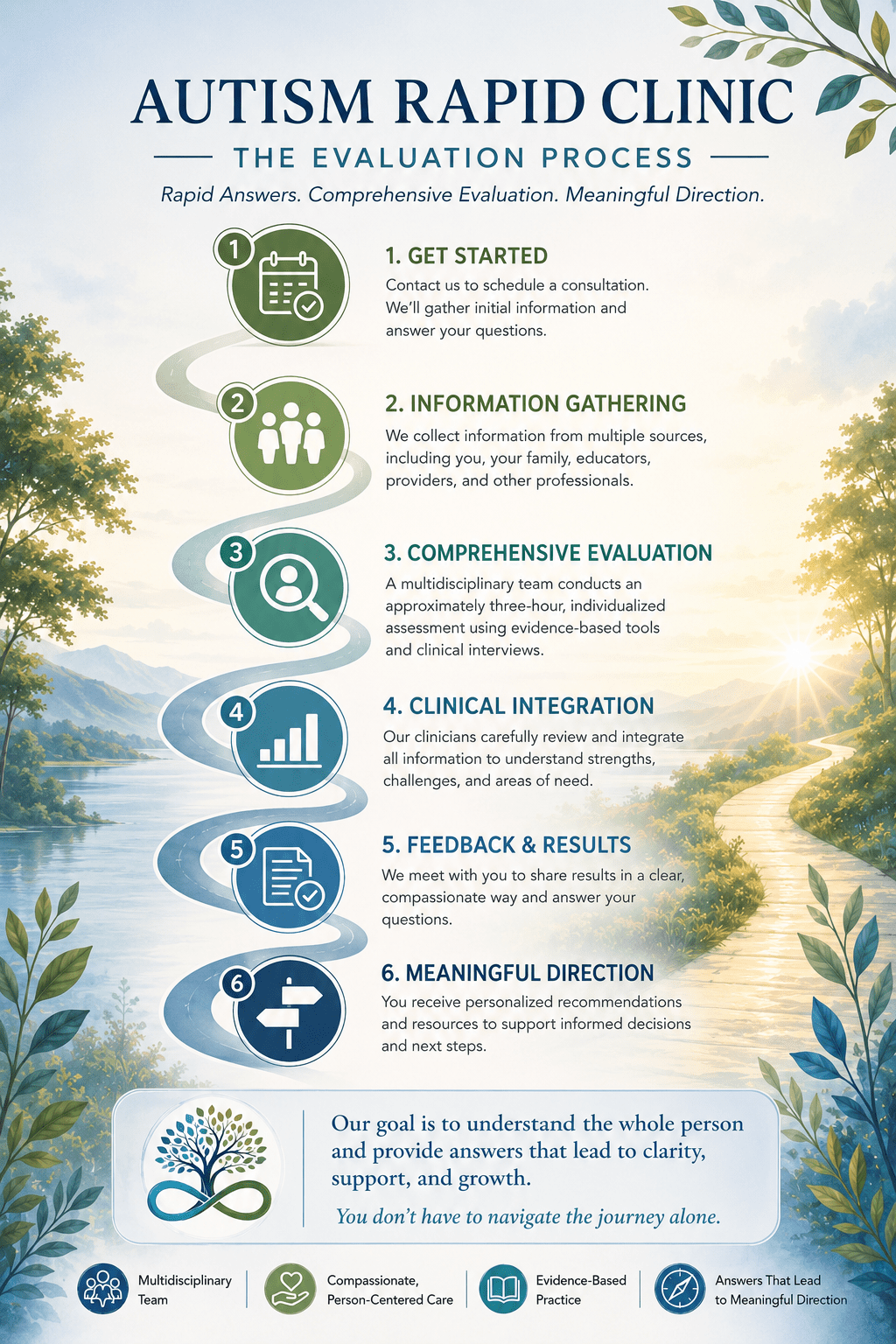
What the ARC process looks like
The process begins when a parent, caregiver, adult client, provider, or referral source contacts the Autism Rapid Clinic. Individuals may:
- call Robinson Psychological Services at (865) 444-4037
- email admin@robinsonpsychological.com
- or submit an inquiry through our website.
A member of our administrative team will collect basic demographic and contact information and answer questions about the evaluation process.
Following registration, individuals and families receive electronic forms and screening measures designed to help our team better understand the referral concerns, developmental history, current functioning, and relevant background information.
This information allows our clinicians to begin the assessment process before the evaluation day and helps ensure that the clinic experience is focused, efficient, and individualized.
On the day of the evaluation, individuals and their caregivers participate in a series of interviews, observations, and evidence-based assessment procedures selected to address the referral questions and diagnostic considerations.
The ARC model utilizes a multidisciplinary approach that integrates information from multiple sources. Depending on the individual’s age, developmental level, communication style, and presenting concerns, the evaluation may include clinical interviews, caregiver interviews, autism-specific assessment procedures, cognitive testing, adaptive functioning measures, behavioral observations, and review of collateral information.
Every evaluation is tailored to the individual. No two assessments are exactly alike because no two individuals are exactly alike.
Following completion of the assessment activities, members of the ARC team review and integrate the information collected throughout the evaluation process.
Diagnostic decisions are never based upon a single test score or isolated observation. Instead, clinicians examine the totality of the available evidence, including developmental history, behavioral observations, collateral information, standardized assessment results, and clinical judgment.
This collaborative review process helps ensure that conclusions are thoughtful, evidence-based, and clinically sound.
Before leaving the clinic, individuals and families meet with members of the evaluation team to review the preliminary findings and discuss the initial clinical impressions.
Families have the opportunity to ask questions, discuss recommendations, and gain a better understanding of the evaluation findings.
When appropriate, an initial diagnostic impression letter is provided at the conclusion of the appointment so that families may begin communicating with medical providers, schools, therapists, employers, or other support systems without unnecessary delay.
The final written report is typically completed within approximately two weeks of the evaluation date.
The report integrates all assessment findings, clinical observations, collateral information, and diagnostic conclusions into a comprehensive document designed to provide meaningful guidance for future treatment, educational planning, accommodations, and support services.